
hope
Our world is burdened with major challenges (e.g., climate crisis, unequal distributions and polarisingsocieties). Such challenges require people (especially designers) to look beyond their egos and have persistence in the long and arduous trajectory towards change. I can remain persistent because I keep seeing examples of how we can do things differently, and that inspires me to hold on to my ideals and inspire others with what I do in return. A dreamer can start realising a better future by searching for a connection with others.
My dream future
I dream of living connected, in harmony with (non)humans.
I design for a better future. In my personal better future, we live in a peaceful, diverse, but also inclusive world. I imagine that we strive for circularity and apply more-than-human-centred design. Designers should recognise themselves as part of complex ecosystems and consider how their design and its materials interact with the world, especially non-humans. Not designing sustainably = having no future. We UNdesign: Sustainability becomes more inclusive through decreasing ownership of makers and users, aiming for more open-source and DIY or local repair/repurpose businesses. The role of the designers will concern thinking about how to make their products undoable or how to design for undoing products sustainably, as well as including people in the transition to a more sustainable society. This relates to Sustainism (Schwarz & Krabbendam, 2013).
creating social impact
If we encounter the unfamiliar with courage and curiosity, empathy could follow.
I want my designs to have a social impact. I think that engaged art (e.g., IN THE MIST OF IT ALL, ABOVE FRONT TEARS by Laure Prouvost (2024)) and critical design (e.g., the work of Viktor Papanek (2020)) can work as a mirror to society and can make people reflect. It can provoke people to switch perspectives and discuss these with others. Maybe instigate empathy and respect through decreasing unfamiliarity between people, others and practices. This idea resembles Contact Theory (Pettigrew & Tropp, 2006). I think involving people with interactive and tangible elements in design or involvement in a design’s development (participatory design) can allow for making connections. Be it with other people, nature or certain processes and systems that people did not understand or know before. These connections create a first step towards a change in perspective and behaviour.
transforming reality
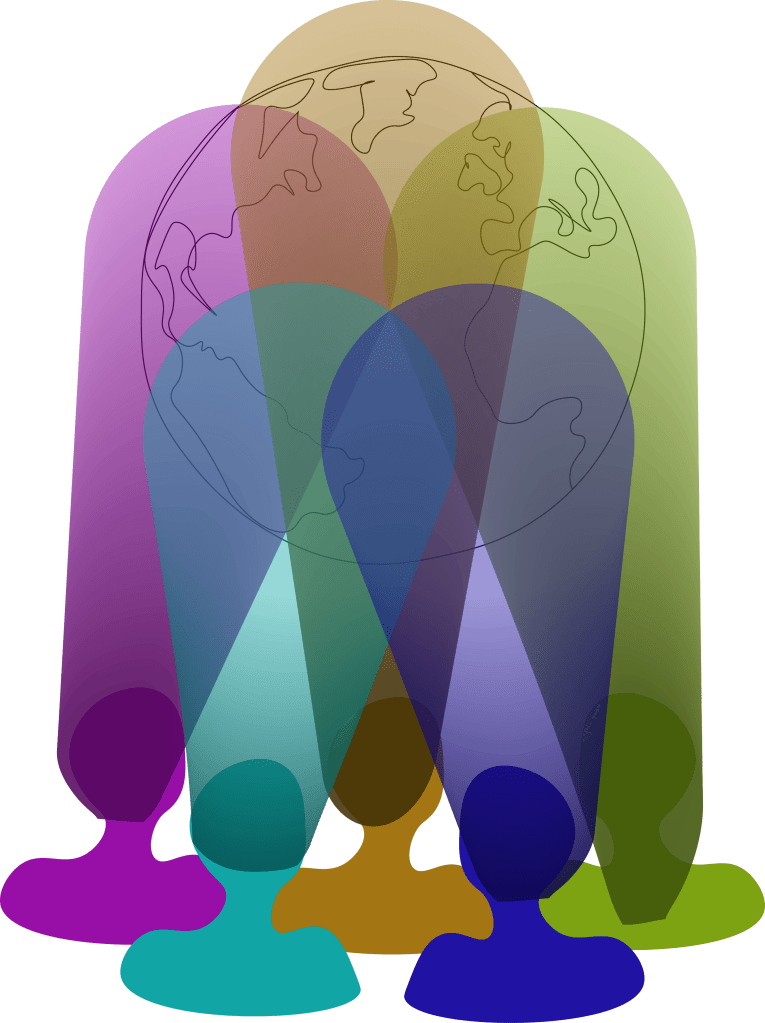
Though we all have limited perspective, we can create the full picture together.
I want to create designs that make people aware of their behaviour and environment. Designs that make people reflect and change the way they live for the better. I think that this better could be the better future as described above. However, I am just one person in a big world, which I eventually can only truly see from my perspective. It is impossible to gain a full overview of the impact of my vision on everyone. Therefore, I think people should decide what this better represents for them, and how they can realise that better future alongside people around them. I see an intrinsic motivation for behaviour transition as the most sustainable. I imagine this being done by giving people autonomy in the transition. By designing together with people for their better future, I aim to increase their commitment and collaboratively contribute to a generally better future. I believe that everyone has personal dreams. These dreams require a world in which there is room for everyone, and non-humans are treated respectfully.
Papanek, V. (2020, October 17). Victor Papanek: The Politics of Design – Design Museum Den Bosch. Design Museum Den Bosch. Retrieved June 9, 2024, from https://designmuseum.nl/tentoonstelling/the-politics-of-design-victor-papanek/
Pettigrew, T. F., & Tropp, L. R. (2006). A meta-analytic test of intergroup contact theory. Journal of Personality and Social Psychology, 90(5), 751–783. https://doi.org/10.1037/0022-3514.90.5.751
Prouvost, L. (2024, February 24). In the mist of it all, above front tears – Museum De Pont. Museum De Pont. Retrieved June 9, 2024, from https://depont.nl/en/exhibition/laure-prouvost-24-februari-2024-18-augustus-2024 Schwarz, M., & Krabbendam, D. (2013). Sustainist Design Guide: How Sharing, Localism, Connectedness and Proportionality Are Creating a New Agenda for Social Design. BIS Publishers.
 Luna Snelder